Vultr vs. DigitalOcean: Which Cloud Platform Truly Delivers in 2026?
In the ever-evolving world of cloud computing, developers, startups, and businesses are constantly searching for reliable, scalable, and cost-efficient infrasVultr and DigitalOcean. B
This in-depth comparison explores performance, pricing, features, usability, and real-world use cases to help you make an informed dec
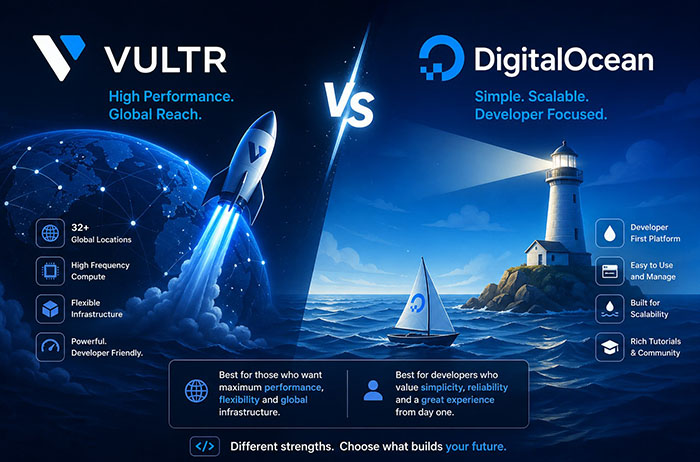
1. Overview: Simplicity Meets Performance
DigitalOcean lau
Vultr entered the scene in 2014
2. Pricing: Transparent vs. Competitive Edge
Pricing is often t
DigitalOcean Pricing
DigitalOcean offers predictable monthly pricing, starting at around $4–$6/month for basic instances. Their pricing includes
- Simple tiers (Basic, General Purpose, CPU-Optimiz
- Flat-rate billing
- Free
However, some advanced features (like managed databases or load balancers) can add up quickly.
V
Vultr is known for aggressive prici
- Plans start as low as $2.50/month
- High-frequency compute options
- Hou
Vultr often unde
Verdict:
If you
3. Performance: Speed, Latency, and Reliabilit
Performance is where the differences become more noticeable.
Vultr Pe
Vultr offer
- High-frequency CPUs (often faster than standard cloud CPUs)
- NVMe SSD storage across many plans
- Strong global data cent
For compute-heavy applications like game servers, trading bots, or real-time analytics, Vultr performs exceptionally well.
DigitalOcean Per
DigitalOcean provides
- Consistent and stable performance
- Premium CPUs in higher-tier plans
- Reliable SSD storage
While slightly less aggressive than Vultr in raw speed, DigitalOcean excels in consistency and uptime.
Verdict:
Vultr leads in raw performance; DigitalOcean leads in stability and predictability.
4. Ease of Use: Developer Experience Matters
DigitalOcean
DigitalOcean is widely praised for its user-friendly interface:
- Clean dashboard
- Excellent documentation
- One-click app deployments (WordPress, Docker, etc.)
It’s ideal for beginners and small teams.
Vultr
Vultr’s interface is straightforward but less polished:
- More technical setup required
- Fewer beginner-friendly guides
- Focus on manual control
Verdict:
DigitalOcean is significantly easier for beginners. Vultr is better suited for users comfortable managing infrastructure manually.
5. Features and Ecosystem
DigitalOcean Features
DigitalOcean offers a well-rounded ecosystem:
- Managed Kubernetes (DOKS)
- Managed databases (PostgreSQL, MySQL, Redis)
- App Platform (PaaS)
- Object storage (Spaces)
It’s essentially a mini AWS with simplicity.
Vultr Features
Vultr focuses on core infrastructure:
- Compute instances
- Bare metal servers
- Block and object storage
- Kubernetes support
While improving, its ecosystem is still less mature than DigitalOcean’s.
Verdict:
DigitalOcean wins for feature completeness. Vultr wins for simplicity and raw infrastructure.
6. Global Data Centers: Coverage and Latency
Vultr
Vultr shines here with:
- 30+ data center locations worldwide
- Strong presence in Asia and Europe
- Low-latency routing
DigitalOcean
DigitalOcean has:
- Fewer locations (around a dozen regions)
- Strong presence in North America and Europe
Verdict:
Vultr offers broader global reach, making it ideal for geographically distributed applications.
7. Customer Support: Help When You Need It
DigitalOcean
- Extensive documentation
- Community tutorials
- Ticket-based support
- Paid support tiers available
Vultr
- Basic documentation
- Ticket-based support
- Faster response times reported by some users
Verdict:
DigitalOcean excels in self-help resources; Vultr is more straightforward but less comprehensive.
8. Use Case Scenarios
Let’s break it down by real-world applications.
Best for Startups & SaaS
DigitalOcean is the better choice due to:
- Managed services
- Faster deployment
- Lower learning curve
Best for High-Performance Apps
Vultr is ideal for:
- Trading systems
- Gaming servers
- Data processing
Best for Developers Learning Cloud
DigitalOcean wins thanks to:
- Tutorials
- Simplicity
- Community support
Best for Global Projects
Vultr’s data center coverage makes it a strong contender.
9. Pros and Cons Summary
DigitalOcean Pros
- Beginner-friendly
- Rich ecosystem
- Strong documentation
- Predictable pricing
DigitalOcean Cons
- Slightly more expensive
- Limited data center locations
Vultr Pros
- High performance
- Competitive pricing
- Wide global coverage
Vultr Cons
- Less beginner-friendly
- Smaller ecosystem
- Limited documentation
10. Security and Reliability
Both platforms provide essential security features:
- Firewalls
- Private networking
- DDoS protection
DigitalOcean slightly edges ahead with more integrated security tools, while Vultr offers strong baseline protection with flexibility.
Final Verdict: Which One Should You Choose?
The answer depends on your priorities.
- Choose DigitalOcean if you want simplicity, managed services, and a smooth developer experience.
- Choose Vultr if you prioritize performance, pricing efficiency, and global reach.
In reality, both platforms are excellent alternatives to more complex cloud providers. The best choice comes down to your technical skill level, project requirements, and growth plans.
Conclusion
The “Vultr vs. DigitalOcean” debate isn’t about which platform is universally better—it’s about which one fits your specific needs. DigitalOcean feels like a polished product built for ease and scalability, while Vultr is a performance-focused powerhouse with global flexibility.
If you’re building your first application or scaling a SaaS product, DigitalOcean will likely give you a smoother experience. But if you’re chasing speed, cost efficiency, and control, Vultr might just be your secret weapon.
Ultimately, the smartest move for many developers in 2026? Try both. Cloud infrastructure is no longer about loyalty—it’s about optimization.