ERP and eCommerce: The Digital Backbone of Modern Business
In the contemporary digital economy, the line between “online shopping” and “business operations” has effectively vanished. As consumers, we see the sleek interface of a website, the “Buy Now” button, and the tracking notification that follows. However, beneath this polished surface lies a complex web of logistics, inventory management, finance, and data processing. To survive and thrive in this environment, businesses must bridge the gap between their front-end sales and back-end operations. This is the intersection of Enterprise Resource Planning (ERP) and eCommerce.
Understanding the Two Pillars
Before diving into the synergy between these two systems, it is essential to define what they bring to the table individually.
1. The Role of eCommerce
eCommerce is the digital storefront—the “face” of the brand. Its primary objective is customer acquisition and conversion. A high-performing eCommerce platform focuses on user experience (UX), site speed, mobile responsiveness, and marketing integrations. It handles the initial transaction, capturing customer data, payment information, and order specifics.
2. The Power of ERP
An ERP system is the “brain” of the organization. It is a centralized software suite that manages core business processes in real-time. This includes:
-
Inventory and Warehouse Management
-
Accounting and Financial Reporting
-
Supply Chain Logistics
-
Human Resources
-
Customer Relationship Management (CRM)
While eCommerce lives in the cloud and interacts with the public, the ERP lives in the warehouse and the accounting office, ensuring that the promises made by the website can actually be kept.
The Pitfalls of “Siloed” Systems
Many growing businesses start by running these two systems independently. This is often referred to as a “siloed” approach. When a customer places an order on the website, an employee must manually export that data and type it into the ERP or accounting software.
This manual intervention creates several critical points of failure:
-
Data Latency: Inventory levels on the website might only update once a day. If a product sells out at noon, the website may continue to take orders until the next manual update, leading to overselling and frustrated customers.
-
Human Error: Manually entering addresses or SKUs inevitably leads to typos, shipping errors, and financial discrepancies.
-
High Operational Costs: As order volume increases, the business must hire more staff just to “bridge the gap” between the two systems, rather than focusing on growth.
The Integration Revolution
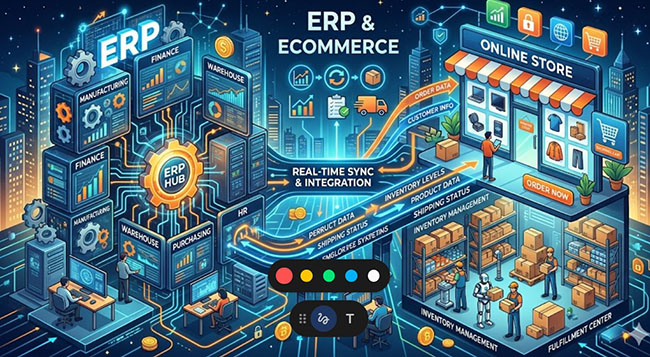
The true magic happens when ERP and eCommerce are integrated into a single, bidirectional flow of data. In an integrated environment, the two systems “talk” to each other constantly.
How Integration Works
When a customer interacts with the web store, the ERP reacts instantly. Conversely, when a shipment arrives at the warehouse and is scanned into the ERP, the eCommerce site updates its stock levels within seconds.
Key Data Touchpoints
-
Inventory Levels: The ERP acts as the “source of truth.” It calculates stock across multiple warehouses and physical stores, pushing accurate numbers to the eCommerce site.
-
Order Processing: The moment an order is placed, it is pushed to the ERP to trigger pick-pack-ship workflows.
-
Pricing and Discounts: Complex pricing tiers (common in B2B) can be managed in the ERP and reflected accurately to specific logged-in users on the web store.
-
Shipping and Tracking: Once the warehouse generates a tracking number in the ERP, it is automatically sent to the eCommerce platform, which then emails the customer.
Strategic Benefits of ERP-eCommerce Synergy
The decision to integrate is often driven by a need for efficiency, but the benefits extend far beyond just saving time.
1. Enhanced Customer Experience
Today’s consumer expects transparency. They want to know if an item is in stock before they click buy, and they want real-time updates on their delivery. Integration ensures that the information the customer sees is always accurate. Furthermore, it allows for “self-service” features, such as viewing past invoices or tracking a return, without needing to call customer support.
2. Data-Driven Decision Making
When your sales data (eCommerce) is unified with your cost data (ERP), you gain a 360-degree view of your profitability. You can see which products have the highest margins after accounting for shipping and storage costs, allowing for more aggressive and intelligent marketing strategies.
3. Scalability
An integrated system is built for growth. Whether you are processing 10 orders a day or 10,000, the workflow remains the same. Automation removes the “bottleneck” of manual data entry, allowing a lean team to manage a massive volume of transactions.
4. B2B Complexity Simplified
For Business-to-Business (B2B) companies, integration is not optional—it’s a requirement. B2B sales often involve custom price lists, credit limits, and bulk ordering. Managing these variables manually on a website is nearly impossible. An ERP-integrated eCommerce site can recognize a specific corporate client and display their unique negotiated prices and payment terms automatically.
Challenges to Implementation
While the benefits are clear, the path to integration is not without its hurdles. It requires a thoughtful strategy and the right technical partner.
-
System Compatibility: Not every ERP plays nice with every eCommerce platform. Choosing systems with robust APIs (Application Programming Interfaces) is crucial.
-
Data Cleaning: Before connecting the systems, the data in both must be “clean.” Inconsistent SKU naming conventions or duplicate customer records can cause the integration to fail or produce garbage data.
-
Cost: The initial investment in integration—whether through middleware or native connectors—can be significant. However, the Return on Investment (ROI) is usually realized quickly through labor savings and reduced error rates.
The Future: AI and Beyond
Looking ahead, the relationship between ERP and eCommerce is becoming even more sophisticated through the use of Artificial Intelligence (AI) and Machine Learning.
Modern ERPs can now use historical eCommerce data to predict future demand. If the system notices a spike in sales for a particular item every June, it can automatically trigger a purchase order to suppliers in April to ensure stock is available. This “predictive commerce” transforms the ERP from a reactive record-keeper into a proactive growth engine.
Furthermore, the rise of “Headless Commerce” is decoupling the front-end user interface from the back-end logic. This allows businesses to sell across multiple touchpoints—social media, mobile apps, IoT devices—while keeping all the data centralized in a single ERP backbone.
Conclusion
In the modern business landscape, ERP and eCommerce are no longer separate entities; they are two halves of a whole. The eCommerce platform captures the spark of consumer interest, while the ERP provides the fuel and machinery to turn that interest into a fulfilled promise.
For businesses looking to remain competitive in an era of instant gratification and global competition, integration is the ultimate differentiator. It replaces chaos with order, guesswork with data, and manual labor with automated precision. By unifying these systems, a business transforms from a collection of departments into a streamlined, digital-first powerhouse ready for the challenges of tomorrow.