Modern enterprises are generating more data than ever before. From AI analytics and cloud-native applications to backup archives and virtual desktop infrastructures, organizations need storage systems that can deliver high capacity, fast performance, and operational efficiency without driving infrastructure costs through the roof. This is where the NetApp Quad Level Cell AFF range enters the conversation.
The introduction of Quad Level Cell (QLC) flash technology into enterprise all-flash arrays marks a major shift in how businesses think about data storage economics. NetApp’s AFF systems powered by QLC SSDs combine the speed advantages of flash storage with greater density and lower cost per terabyte. The result is a compelling solution for enterprises that need scalable storage capable of handling modern workloads while maintaining predictable performance.
Understanding Quad Level Cell Technology
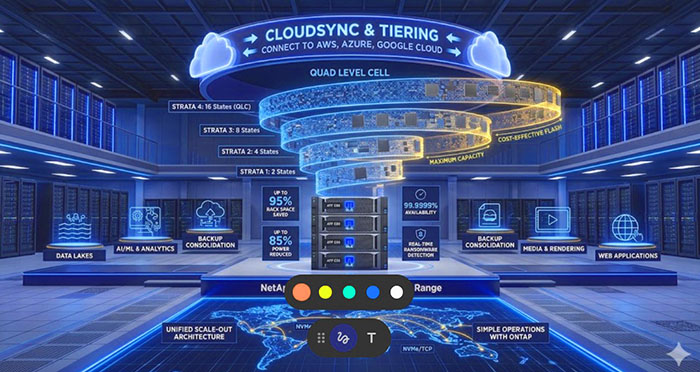
Quad Level Cell flash memory stores four bits of data per memory cell. Traditional Single Level Cell (SLC) stores one bit per cell, while Multi-Level Cell (MLC) stores two bits and Triple Level Cell (TLC) stores three bits. By increasing the number of bits per cell, QLC dramatically improves storage density.
The primary advantage of QLC technology is cost efficiency. Because more data can be stored in the same physical space, manufacturers can reduce the overall price per gigabyte. This allows enterprises to deploy larger all-flash environments without exceeding budget limitations.
Historically, QLC SSDs were viewed primarily as consumer-grade storage because earlier generations had limitations related to endurance and write performance. However, modern enterprise QLC solutions have evolved significantly. Advanced controllers, intelligent caching systems, and optimized storage operating systems have enabled vendors like NetApp to make QLC viable for many enterprise workloads.
The Evolution of NetApp AFF Systems
NetApp has long been recognized as a leader in enterprise storage innovation. Its AFF (All Flash FAS) family has become popular among businesses seeking high-performance, low-latency storage for mission-critical applications.
Traditional AFF arrays relied heavily on TLC SSDs to deliver enterprise-grade performance and endurance. While effective, these systems often came with higher acquisition costs, particularly for organizations managing petabyte-scale environments.
The addition of QLC-based models to the AFF lineup represents a strategic evolution. NetApp recognized that many enterprise workloads are read-intensive rather than write-intensive. These workloads benefit greatly from flash performance but do not necessarily require the premium endurance characteristics of TLC or SLC storage.
By integrating QLC flash into the AFF portfolio, NetApp created a storage tier capable of supporting large-scale workloads such as:
- File sharing and collaboration
- Backup and recovery repositories
- AI and analytics datasets
- Media streaming archives
- Virtual desktop infrastructure
- Cloud-native applications
- DevOps environments
This expanded the accessibility of enterprise all-flash storage to organizations that previously relied on slower hybrid systems or traditional hard disk arrays.
Key Features of the NetApp QLC AFF Range
High-Density Storage Architecture
One of the standout features of the NetApp QLC AFF range is density optimization. QLC SSDs allow significantly more usable capacity within a smaller rack footprint.
This is especially valuable for organizations operating in colocation facilities or data centers where space and power consumption are expensive. By reducing the number of racks needed for large storage deployments, businesses can lower operational costs while simplifying infrastructure management.
Higher density also supports scalability. Enterprises can expand capacity without major architectural redesigns or additional floor space requirements.
Intelligent Data Management
NetApp’s ONTAP operating system plays a critical role in maximizing the effectiveness of QLC storage. ONTAP includes advanced data management capabilities that help mitigate some of the traditional limitations associated with QLC technology.
Features such as inline deduplication, compression, compaction, and thin provisioning reduce the amount of physical storage consumed. This allows organizations to achieve even greater efficiency from their QLC arrays.
Additionally, automated tiering mechanisms intelligently move cold data to lower-cost storage resources when appropriate, helping businesses optimize performance and cost simultaneously.
Enterprise-Class Reliability
Although QLC technology initially raised concerns about endurance, NetApp addresses reliability through several engineering enhancements.
The AFF range incorporates:
- Advanced wear-leveling algorithms
- Intelligent caching strategies
- Error correction technologies
- Predictive analytics
- Redundant architecture design
NetApp Active IQ monitoring further enhances system reliability by using AI-driven analytics to identify potential issues before they impact operations.
These protections make QLC AFF systems suitable for many enterprise production environments.
Simplified Cloud Integration
Modern storage infrastructure must integrate seamlessly with hybrid and multi-cloud strategies. NetApp has invested heavily in cloud connectivity, enabling its AFF systems to function effectively across on-premises and cloud ecosystems.
Organizations can replicate data between AFF arrays and public cloud platforms for disaster recovery, backup, or workload mobility. This flexibility supports digital transformation initiatives while maintaining centralized management and security controls.
The QLC AFF range fits particularly well into cloud-adjacent workloads where large datasets need rapid access at reasonable cost levels.
Performance Characteristics
Performance remains one of the most important considerations when evaluating enterprise flash storage. While QLC SSDs may not match the raw write endurance of TLC or SLC drives, they still provide substantial advantages over traditional spinning disks.
NetApp’s architecture compensates for many QLC limitations through intelligent software optimization.
Typical performance benefits include:
- Reduced latency for read-intensive workloads
- Faster application response times
- Improved virtualization performance
- Accelerated backup and restore operations
- High throughput for analytics workloads
For many organizations, the real-world performance difference between enterprise TLC and QLC arrays is minimal for targeted workloads. This makes QLC an attractive alternative for environments prioritizing capacity efficiency.
Ideal Use Cases for NetApp QLC AFF Systems
Backup Modernization
Traditional backup repositories often relied on hard disk systems because of their lower cost. However, recovery speed has become increasingly important as ransomware attacks and business continuity requirements intensify.
QLC AFF arrays provide fast restore capabilities while remaining more cost-effective than premium flash tiers. This allows organizations to modernize backup infrastructure without massive budget increases.
Artificial Intelligence and Analytics
AI workloads often involve extremely large datasets with heavy read activity. QLC storage is well suited for these environments because it delivers fast data access while supporting massive capacity requirements.
Data scientists and analytics teams can benefit from reduced processing times and improved workflow efficiency.
Virtual Desktop Infrastructure
VDI environments generate demanding storage patterns, especially during boot storms and peak login periods. NetApp QLC AFF systems help maintain responsive user experiences while supporting large-scale deployments.
The combination of flash performance and storage efficiency makes QLC particularly appealing for educational institutions, government agencies, and enterprises with distributed workforces.
Media and Entertainment Archives
Video production, digital content creation, and media streaming companies require storage systems capable of managing enormous files efficiently.
QLC AFF arrays provide sufficient performance for active archive workloads while reducing storage costs associated with large media libraries.
Economic Advantages
Cost optimization remains one of the strongest arguments for QLC enterprise storage adoption.
Compared to traditional TLC all-flash systems, QLC arrays can significantly reduce acquisition costs per terabyte. This enables organizations to deploy more flash storage within existing IT budgets.
Additional savings may include:
- Reduced power consumption
- Lower cooling requirements
- Smaller physical footprint
- Simplified infrastructure management
- Decreased maintenance complexity
When combined with NetApp’s data reduction technologies, effective storage efficiency ratios can become highly attractive for large-scale deployments.
Challenges and Considerations
Despite its benefits, QLC technology is not ideal for every workload.
Highly write-intensive applications such as high-frequency transaction databases may still perform better on TLC or SLC-based systems. Organizations should carefully analyze workload characteristics before deployment.
Proper workload placement is critical. NetApp’s portfolio flexibility allows businesses to combine multiple storage tiers, ensuring that each application receives the appropriate balance of performance, endurance, and cost.
IT teams should also consider future growth projections, replication requirements, and data protection strategies when designing QLC-based architectures.
The Future of Enterprise Flash Storage
The adoption of QLC technology reflects a broader industry trend toward affordable, high-density flash infrastructure. As flash memory technology continues evolving, the gap between premium and capacity-oriented storage tiers is likely to narrow further.
NetApp’s investment in QLC AFF systems demonstrates confidence in the long-term viability of enterprise QLC deployments. Advances in controller intelligence, AI-driven optimization, and NAND manufacturing will continue improving endurance and performance characteristics.
For many enterprises, QLC represents the next phase of storage modernization — delivering the benefits of all-flash infrastructure to workloads that were previously considered too large or expensive for flash adoption.
Conclusion
The NetApp Quad Level Cell AFF range represents an important evolution in enterprise storage strategy. By combining the affordability and density of QLC flash with the intelligence of the ONTAP ecosystem, NetApp offers organizations a practical way to scale all-flash infrastructure for modern workloads.
These systems are particularly well suited for read-intensive applications, large-scale archives, AI datasets, backup environments, and virtualization platforms. They provide a strong balance between performance, capacity, and operational efficiency.
As enterprises continue managing explosive data growth, solutions like the NetApp QLC AFF range will play a central role in helping businesses achieve scalable, cost-effective, and future-ready storage infrastructure.