How AI Gardening Technology Is Transforming Modern Agriculture
Modern agriculture is experiencing one of the most significant technological revolutions in history. Artificial intelligence (AI), once associated only with robotics and computer science, is now becoming an essential part of farming and gardening practices worldwide. From automated irrigation systems to predictive crop monitoring, AI gardening technology is reshaping how food is grown, managed, and distributed. As global populations continue to rise and climate change creates new agricultural challenges, farmers are turning to intelligent solutions to improve productivity, reduce waste, and ensure long-term sustainability.
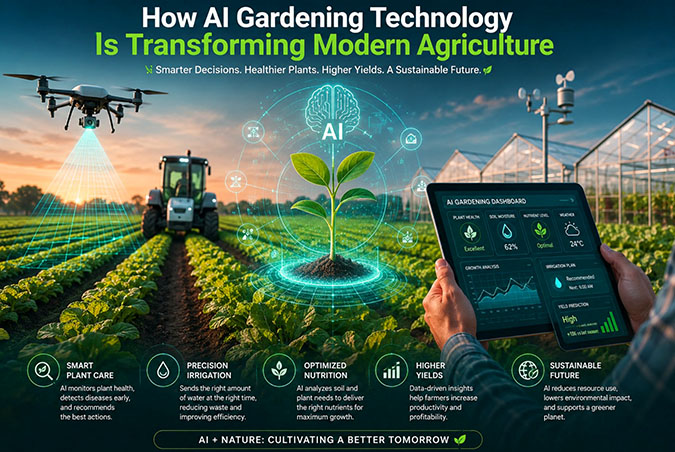
AI gardening technology combines machine learning, computer vision, robotics, and data analytics to optimize agricultural operations. These systems collect and analyze vast amounts of information about soil conditions, weather patterns, crop health, and pest activity. Using this data, AI-powered tools can make accurate recommendations or even perform tasks automatically without constant human intervention. The result is smarter farming that saves time, conserves resources, and increases yields.
One of the most important contributions of AI in modern agriculture is precision farming. Traditional farming often relies on generalized practices, where water, fertilizer, and pesticides are applied evenly across entire fields. However, not all plants require the same amount of care. AI systems can analyze individual sections of farmland and determine exactly what each area needs. This targeted approach reduces resource waste while maximizing crop performance.
For example, smart irrigation systems use AI algorithms to monitor soil moisture levels and weather forecasts in real time. Instead of watering crops on a fixed schedule, these systems deliver water only when necessary. This not only conserves water but also prevents overwatering, which can damage plant roots and reduce crop quality. In regions suffering from drought or water scarcity, AI-driven irrigation can significantly improve agricultural sustainability.
AI gardening technology is also transforming pest and disease management. Farmers have traditionally relied on manual inspections to identify plant diseases or insect infestations. This process can be slow and inaccurate, especially on large farms. Today, AI-powered cameras and drones can scan fields continuously and detect problems at an early stage. Machine learning models are trained to recognize specific symptoms on leaves, stems, or fruits, allowing farmers to respond before entire crops are affected.
Early detection offers enormous economic benefits. By identifying diseases quickly, farmers can treat only the affected areas rather than spraying entire fields with chemicals. This reduces pesticide use, lowers costs, and minimizes environmental damage. Consumers also benefit from healthier produce grown with fewer harmful substances.
Robotics is another area where AI gardening technology is making a major impact. Autonomous farming machines can now perform labor-intensive tasks such as planting, weeding, harvesting, and pruning. These robots use AI vision systems to identify crops and navigate fields with high precision. In many countries, labor shortages have become a serious issue for agriculture. AI-powered robots help farmers maintain productivity even when skilled workers are difficult to find.
Harvesting robots are especially valuable for delicate fruits and vegetables that require careful handling. AI systems can determine ripeness based on color, size, and texture, ensuring that crops are harvested at the ideal time. This improves food quality and reduces waste caused by premature or delayed harvesting.
Greenhouse farming has also benefited enormously from AI integration. Smart greenhouses use sensors and automated controls to regulate temperature, humidity, lighting, and ventilation. AI software analyzes environmental conditions continuously and adjusts settings to create optimal growing environments. As a result, plants can grow faster and healthier while consuming fewer resources.
Indoor vertical farming represents another exciting development powered by AI gardening technology. Vertical farms stack crops in layers inside controlled indoor facilities, often located in urban areas. AI systems manage every aspect of the growing process, from nutrient delivery to artificial lighting schedules. Because these farms operate in controlled environments, they can produce crops year-round regardless of weather conditions. This approach reduces transportation costs and allows fresh produce to reach consumers more quickly.
Data analysis is one of the greatest strengths of AI in agriculture. Modern farms generate massive amounts of information through sensors, satellites, drones, and machinery. AI systems can process this data far more efficiently than humans. By identifying patterns and trends, AI helps farmers make informed decisions about planting schedules, crop rotation, fertilization, and market timing.
Predictive analytics is particularly valuable in dealing with climate uncertainty. Weather changes can dramatically affect agricultural productivity, and traditional forecasting methods are often insufficient. AI models can analyze historical weather data, satellite imagery, and climate trends to predict future conditions with remarkable accuracy. Farmers can then adjust their strategies to minimize risks associated with droughts, floods, heatwaves, or unexpected frost.
AI gardening technology is also supporting sustainable agriculture practices. Environmental concerns have become increasingly important as industrial farming contributes to soil degradation, water pollution, and greenhouse gas emissions. AI helps reduce environmental impact by optimizing resource usage and encouraging eco-friendly farming techniques.
For instance, AI-driven fertilizer management systems apply nutrients only where they are needed. Excess fertilizer often contaminates waterways and damages ecosystems. Precise application not only protects the environment but also reduces costs for farmers. Similarly, AI-powered weed detection systems allow robots to remove weeds mechanically instead of relying heavily on herbicides.
Another major advantage of AI agriculture is improved food security. The global population is expected to exceed nine billion people within the coming decades, increasing demand for food production. At the same time, agricultural land is shrinking due to urbanization and environmental pressures. AI technology enables farmers to grow more food using fewer resources, helping meet future demand without excessive expansion of farmland.
Small-scale farmers can also benefit from AI gardening tools. Mobile applications powered by AI provide recommendations about planting methods, disease treatment, and weather forecasting. In developing regions, these technologies give farmers access to expert-level agricultural advice that was previously unavailable. As smartphone usage continues to expand globally, AI-driven farming support becomes increasingly accessible.
Despite its many benefits, AI gardening technology still faces several challenges. High implementation costs remain a barrier for some farmers, particularly in developing countries. Advanced AI systems, drones, and robotics require significant investment. Additionally, farmers may need technical training to operate and maintain these technologies effectively.
Data privacy and cybersecurity are also growing concerns. Smart farming systems collect large amounts of sensitive information about land, production levels, and operational strategies. Protecting this data from cyber threats is essential to maintaining trust and stability within the agricultural industry.
There are also concerns about overdependence on technology. While AI can improve efficiency, farming still requires human judgment, creativity, and experience. Successful agriculture depends on balancing technological innovation with traditional farming knowledge.
Looking ahead, the future of AI gardening technology appears extremely promising. Researchers are developing increasingly advanced systems capable of fully autonomous farming operations. Future AI tools may use real-time genetic analysis, advanced robotics, and even quantum computing to optimize agricultural production further.
Integration with renewable energy sources could also enhance sustainability. Solar-powered AI farming systems may allow remote farms to operate efficiently without relying heavily on fossil fuels. Meanwhile, blockchain technology combined with AI could improve food traceability, allowing consumers to track produce from farm to table.
Educational institutions and governments are also investing heavily in agricultural AI research. These investments are accelerating innovation and helping farmers adapt to rapidly changing conditions. As technology becomes more affordable and accessible, AI gardening tools are likely to become standard equipment on farms of all sizes.
In conclusion, AI gardening technology is fundamentally transforming modern agriculture. Through precision farming, automated irrigation, robotics, predictive analytics, and sustainable resource management, AI is helping farmers produce more food with greater efficiency and lower environmental impact. While challenges such as cost and technical complexity remain, the long-term benefits are undeniable. As the agricultural sector continues to evolve, AI will play a central role in building a smarter, more sustainable, and food-secure future for the world.