Best Greenhouse Automation Tools for High-Income Farming Businesses
Modern greenhouse farming is no longer driven by manual labor alone. Today’s high-income farming businesses rely on automation, artificial intelligence, and precision agriculture systems to maximize yields while reducing waste, labor costs, and operational risks. From climate control software to sensor-driven irrigation, greenhouse automation tools have become essential for commercial growers who want consistent crop quality and year-round profitability.
The global shift toward smart agriculture is accelerating because greenhouse operators face rising labor expenses, unpredictable climate conditions, and increasing demand for premium produce. Industry reports show that advanced greenhouse automation can significantly reduce labor requirements while improving crop consistency and resource efficiency.
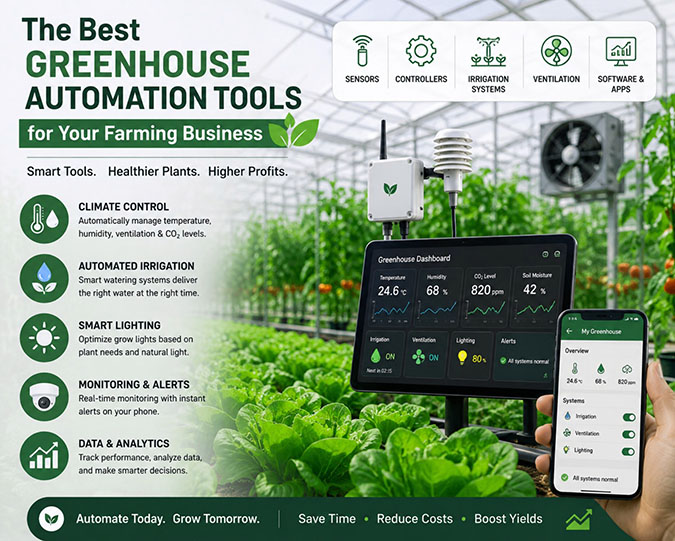
Why Automation Matters in Commercial Greenhouse Farming
High-income greenhouse operations depend on stability and scalability. Manual systems often lead to inconsistent watering, temperature fluctuations, and delayed responses to disease or environmental stress. Automation solves these issues by creating real-time monitoring and control systems that work continuously.
Smart greenhouse platforms now integrate:
- Climate management
- Irrigation and fertigation
- AI-powered crop analytics
- Remote monitoring
- Energy optimization
- Pest and disease detection
- Yield forecasting
Research from controlled-environment agriculture projects shows that AI-driven climate systems can improve climate stability and reduce energy consumption substantially in commercial greenhouse operations.
1. AI Climate Control Systems
Climate control is the foundation of greenhouse automation. Crops require stable temperature, humidity, airflow, and CO2 levels to achieve maximum productivity.
Modern AI-powered climate systems continuously analyze greenhouse conditions using sensor networks. These systems automatically adjust:
- Ventilation fans
- Heating systems
- Cooling pads
- Misting systems
- Shade curtains
- CO2 injectors
Advanced climate automation platforms can also analyze weather forecasts and adapt greenhouse settings before environmental changes occur. According to greenhouse technology reports, predictive climate control reduces plant stress and improves crop uniformity.
Leading greenhouse management platforms such as Priva and Ridder are widely used in large-scale commercial greenhouse operations for environmental automation and multi-zone climate control.
Key Benefits
- Lower energy costs
- Improved crop consistency
- Reduced disease outbreaks
- Better seasonal production planning
- Higher overall yields
2. Smart Irrigation and Fertigation Systems
Water management is one of the most important aspects of profitable greenhouse farming. Overwatering wastes nutrients and encourages disease, while underwatering reduces growth rates and crop quality.
Smart irrigation systems use soil moisture sensors, water-flow monitoring, and automated drip systems to deliver precise amounts of water exactly when plants need it.
Fertigation systems take automation even further by injecting nutrients directly into irrigation lines according to crop growth stages and environmental conditions.
Modern irrigation automation platforms help greenhouse businesses:
- Reduce water waste
- Lower fertilizer costs
- Improve nutrient absorption
- Prevent root diseases
- Increase production efficiency
Research on IoT-based irrigation systems has shown significant reductions in water usage while maintaining stable moisture levels through automated sensor-driven watering systems.
Companies such as Netafim and CropX provide advanced irrigation analytics and fertigation management tools designed for precision agriculture.
3. IoT Sensor Networks
Internet of Things (IoT) technology is transforming greenhouse farming into a data-driven business model. Wireless sensor networks continuously monitor environmental conditions and send real-time information to centralized dashboards.
Common greenhouse sensors monitor:
- Temperature
- Humidity
- Soil moisture
- Light intensity
- CO2 concentration
- Water pH
- Electrical conductivity (EC)
Instead of relying on manual inspections, growers receive instant alerts if conditions move outside target ranges.
IoT systems also generate long-term historical data, helping greenhouse businesses identify patterns, optimize production schedules, and improve decision-making over time.
According to recent smart greenhouse studies, integrated sensor networks are now central to autonomous greenhouse development.
4. Greenhouse Management Software
Commercial greenhouse operations generate enormous amounts of data every day. Without centralized management software, it becomes difficult to coordinate labor, crop scheduling, irrigation, inventory, and environmental control.
Modern greenhouse management software combines multiple functions into a single dashboard.
These platforms often include:
- Crop scheduling
- Environmental monitoring
- Yield forecasting
- Employee management
- Production analytics
- Supply chain tracking
- Automated reporting
Industry reviews show that greenhouse software is evolving from simple monitoring tools into fully integrated operational management systems.
Popular enterprise-level systems include:
- Agrivi
- Microsoft Dynamics 365
- FarmBot
- CropX
These tools help greenhouse businesses scale operations without losing operational efficiency.
5. Automated Lighting Systems
Lighting automation is essential for greenhouse businesses producing crops year-round. Smart LED systems automatically adjust intensity and spectrum based on crop requirements, daylight conditions, and production schedules.
Advanced lighting automation improves:
- Photosynthesis efficiency
- Plant growth speed
- Crop coloration
- Flowering cycles
- Energy savings
Modern greenhouse lighting systems also integrate with weather forecasting tools and climate control software to optimize electricity consumption.
Recent greenhouse technology reports highlight tunable full-spectrum LED systems as a major advancement in controlled-environment agriculture.
6. Robotics and Automated Labor Solutions
Labor shortages are one of the biggest challenges facing commercial greenhouse operations. Automation tools increasingly include robotic systems that reduce dependence on manual workers.
Greenhouse robotics can perform:
- Seeding
- Transplanting
- Harvesting
- Sorting
- Packaging
- Crop monitoring
Automated mobile robots equipped with cameras and AI systems can also detect disease symptoms before they spread across entire crop zones.
Industry experts report that greenhouse automation is becoming essential infrastructure because of rising labor costs and workforce shortages.
7. AI Analytics and Predictive Farming
Artificial intelligence is changing greenhouse management from reactive farming to predictive farming.
AI systems analyze massive datasets collected from sensors, cameras, climate systems, and historical crop performance. These platforms can predict:
- Disease outbreaks
- Irrigation needs
- Yield outcomes
- Nutrient deficiencies
- Climate risks
- Energy consumption patterns
Researchers developing explainable AI greenhouse systems have demonstrated high accuracy in automated greenhouse decision-making using environmental sensor data.
Predictive farming allows greenhouse operators to make proactive decisions that increase profitability while reducing operational risks.
The Financial Benefits of Greenhouse Automation
For high-income farming businesses, automation is ultimately about profitability and scalability.
The financial advantages include:
Reduced Labor Costs
Automated systems reduce manual monitoring, watering, and climate adjustments. Some smart greenhouse platforms report major labor reductions through centralized automation.
Higher Crop Quality
Consistent environmental control improves uniformity, shelf life, and visual quality, allowing growers to target premium markets.
Increased Yields
Precision climate and irrigation systems help plants grow under ideal conditions throughout the entire production cycle.
Better Resource Efficiency
Automation reduces waste in:
- Water
- Fertilizer
- Electricity
- Heating
- Cooling
Remote Management
Cloud-based dashboards allow greenhouse owners to monitor operations from anywhere using mobile devices.
Choosing the Right Automation Tools
Not every greenhouse business requires the same level of automation. The best strategy is to scale technology based on operation size, crop type, and investment capacity.
For most commercial growers, the ideal automation roadmap includes:
- Environmental sensors
- Climate automation
- Smart irrigation
- Centralized management software
- AI analytics
- Robotics integration
Experts in greenhouse technology recommend phased implementation because it allows businesses to adapt systems gradually while maintaining operational stability.
Final Thoughts
Greenhouse automation is rapidly becoming the standard for profitable commercial agriculture. High-income farming businesses can no longer rely solely on traditional greenhouse management methods if they want to remain competitive in modern food production markets.
The combination of AI, IoT sensors, smart irrigation, robotics, and predictive analytics creates highly efficient farming systems capable of producing premium crops with greater consistency and lower operational costs.
As technology continues to evolve, fully autonomous greenhouses are becoming increasingly realistic. Businesses that invest early in automation tools will be better positioned to scale production, improve sustainability, and dominate high-value agricultural markets in the years ahead.