The Best High-Tech Hydroponic Tools for Profitable Urban Farming
Urban farming is no longer a niche hobby practiced only by eco-conscious gardeners. Today, it has evolved into a profitable business model powered by advanced hydroponic technology, smart automation, and data-driven farming systems. As cities continue to grow and food demand rises, hydroponic farming offers a sustainable way to produce fresh vegetables, herbs, and fruits in limited spaces. Modern urban farmers are now turning to high-tech tools that improve efficiency, reduce labor costs, and maximize yields.
Hydroponics itself is a soil-free farming method where plants grow in nutrient-rich water solutions. Compared to traditional agriculture, hydroponic systems use significantly less water and allow faster plant growth. Many commercial growers now combine hydroponics with automation technologies to create intelligent indoor farms capable of producing crops year-round.
The success of an urban hydroponic farm depends heavily on the quality of tools and equipment used. Smart sensors, automated nutrient dosing systems, climate controllers, and energy-efficient grow lights can dramatically increase productivity while minimizing waste. Here are the best high-tech hydroponic tools every profitable urban farmer should consider.
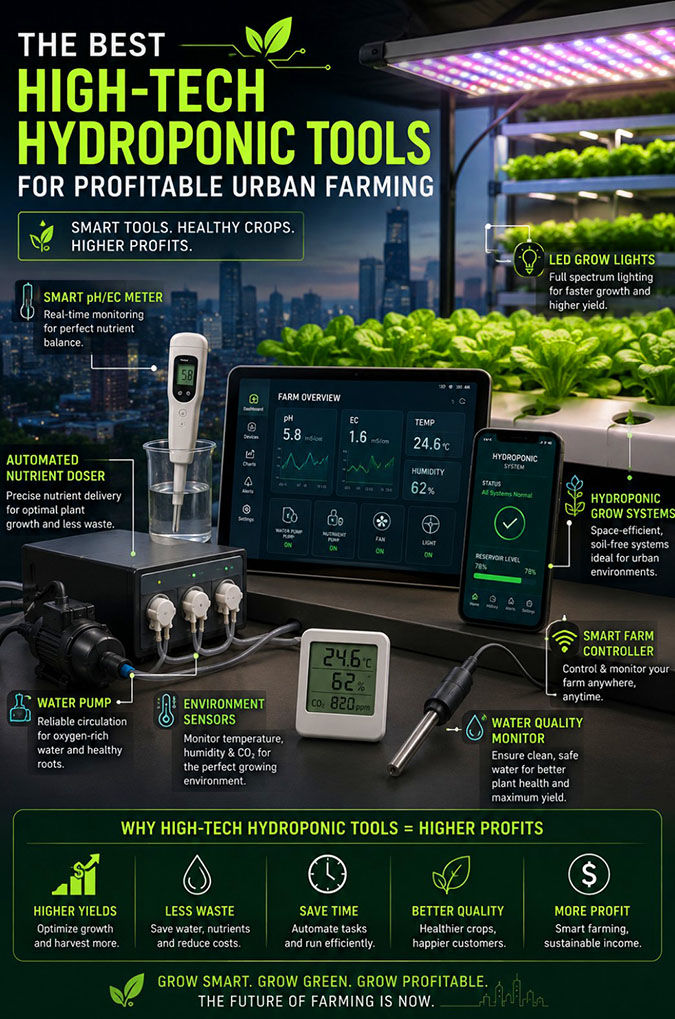
Smart LED Grow Lights
Lighting is one of the most important factors in hydroponic farming because indoor plants rely entirely on artificial light for photosynthesis. Traditional lighting systems consume excessive electricity and generate unwanted heat. Modern full-spectrum LED grow lights have transformed indoor farming by providing customizable lighting while reducing energy consumption.
Advanced LED systems allow farmers to adjust light intensity and spectral output according to different plant growth stages. Blue wavelengths promote vegetative growth, while red wavelengths encourage flowering and fruiting. Some premium grow lights even simulate natural daylight cycles automatically through mobile apps and smart controllers.
Smart LED grow lights offer several advantages:
- Lower electricity costs
- Reduced heat generation
- Faster plant growth
- Improved crop quality
- Longer equipment lifespan
For urban farms operating in warehouses, rooftops, or apartments, efficient LED technology can significantly increase profitability.
Automated Nutrient Dosing Systems
Nutrient management is critical in hydroponics because plants depend entirely on water-based nutrients for growth. Small nutrient imbalances can quickly damage crops or reduce yields. High-tech nutrient dosing systems automatically monitor and adjust nutrient concentrations in real time.
Modern automation platforms such as GEIA.AI use sensors to track pH, EC (electrical conductivity), and nutrient levels continuously. When readings fall outside the ideal range, dosing pumps automatically inject the required nutrients or pH adjustments into the reservoir.
Automated nutrient systems provide major benefits:
- Consistent nutrient balance
- Reduced human error
- Faster crop growth
- Lower fertilizer waste
- Reduced labor requirements
For commercial urban farms, automated nutrient dosing helps maintain stable production while allowing farmers to manage larger growing operations with fewer workers.
pH and EC Monitoring Sensors
Accurate monitoring tools are essential for maintaining healthy hydroponic systems. Two of the most important measurements in hydroponics are pH and EC levels.
The pH level affects nutrient absorption. Most hydroponic crops grow best within a pH range of 5.5 to 6.5. EC meters measure nutrient concentration in the water solution. If EC levels are too high or too low, plants may suffer nutrient burn or deficiencies.
Modern digital sensors continuously monitor these parameters and send alerts to smartphones or cloud dashboards. Some advanced systems integrate directly with automation platforms to adjust water chemistry automatically.
Wireless sensor technology now allows urban farmers to remotely monitor multiple growing zones from anywhere. This capability is especially valuable for commercial growers operating vertical farms or greenhouse facilities.
Smart Climate Control Systems
Temperature, humidity, airflow, and carbon dioxide levels play a major role in plant health and productivity. Poor environmental conditions can slow plant growth, increase disease risk, and reduce overall profits.
High-tech climate control systems use sensors and automation software to maintain ideal growing conditions 24/7. Advanced controllers regulate:
- Temperature
- Humidity
- Ventilation
- Air circulation
- CO2 concentration
Many smart farming systems provide real-time environmental analytics and automated alerts when conditions become unstable.
By stabilizing the growing environment, urban farmers can achieve:
- Faster crop cycles
- Higher yields
- Reduced crop losses
- Better produce quality
- Lower energy waste
Climate automation is especially important for urban farms operating in hot climates or enclosed indoor spaces.
IoT-Based Farm Management Platforms
The Internet of Things (IoT) has revolutionized modern hydroponic farming. IoT platforms connect sensors, controllers, pumps, lighting systems, and cameras into one centralized management system.
Researchers have demonstrated that IoT-powered hydroponic systems allow growers to remotely monitor environmental conditions and automate farm operations with greater precision.
Today’s smart farm software platforms can:
- Track crop growth data
- Monitor water quality
- Control irrigation schedules
- Analyze production trends
- Generate performance reports
- Send instant smartphone alerts
Data-driven farming allows urban growers to optimize every aspect of production. Over time, these insights improve crop consistency and profitability.
Automated Irrigation Systems
Efficient irrigation is one of hydroponics’ greatest advantages. Unlike traditional farming, hydroponic systems recycle water continuously, reducing water waste dramatically. Smart irrigation systems improve this efficiency even further.
Automated irrigation controllers deliver precise amounts of nutrient solution according to plant requirements and growth stages. Flow sensors detect clogs, leaks, or pump failures before they damage crops. Some systems even include backup watering functions during power outages.
Automated irrigation offers several business advantages:
- Reduced water consumption
- Lower labor costs
- Consistent plant growth
- Improved nutrient absorption
- Reduced system downtime
In urban environments where water costs can be high, efficient irrigation directly improves profit margins.
AI-Powered Crop Monitoring
Artificial intelligence is becoming increasingly important in commercial hydroponic farming. AI-powered monitoring systems analyze data collected from sensors, cameras, and environmental controls to predict crop performance and detect problems early.
Some advanced systems use machine learning algorithms to identify:
- Nutrient deficiencies
- Pest infestations
- Plant diseases
- Growth abnormalities
- Environmental stress
AI can also recommend optimal lighting schedules, nutrient formulas, and climate adjustments based on previous harvest performance.
By reducing guesswork, AI technology helps urban farmers make smarter decisions that increase productivity and reduce losses.
Smart Water Pumps and Aeration Systems
Healthy plant roots require oxygen-rich water circulation. Modern hydroponic systems rely on high-efficiency pumps and aerators to maintain proper oxygen levels and nutrient flow.
Smart pumps can automatically adjust flow rates based on crop requirements and environmental conditions. Some systems include sensors that detect blockages or equipment failures instantly. Air pumps and air stones improve root oxygenation, helping plants absorb nutrients more effectively.
Efficient water circulation contributes to:
- Faster root growth
- Healthier plants
- Reduced root diseases
- Higher yields
- More stable nutrient delivery
Reliable pumps are especially critical in commercial vertical farming systems where uninterrupted water flow is essential.
Remote Monitoring Cameras
Modern urban farms increasingly use smart cameras for remote monitoring and crop analysis. High-resolution cameras allow growers to observe plant health, identify diseases, and track crop development without physically visiting every growing section.
Some advanced platforms provide live camera feeds and time-lapse recording features integrated with environmental data dashboards.
Remote monitoring improves operational efficiency while reducing labor requirements, especially in larger indoor farming facilities.
The Future of High-Tech Urban Farming
The future of urban farming will be driven by automation, artificial intelligence, robotics, and sustainable growing systems. As technology becomes more affordable, even small-scale growers can access advanced hydroponic tools previously limited to commercial greenhouses.
Modern hydroponic systems are transforming food production by allowing farmers to grow more crops using less water, less land, and fewer resources. High-tech tools not only improve efficiency but also make urban farming more scalable and profitable.
For entrepreneurs entering the hydroponic industry, investing in smart technology can create a significant competitive advantage. Automated systems reduce manual labor, improve crop consistency, and increase production capacity. In highly competitive urban markets, these benefits can make the difference between an average farm and a highly profitable one.
As cities continue searching for sustainable food solutions, high-tech hydroponic farming will likely become one of the most important agricultural industries of the future.