Best Agricultural Drones for Precision Farming and Crop Management
Agriculture has entered a new era driven by technology, data, and automation. Among the most transformative innovations reshaping modern farming are agricultural drones. These unmanned aerial vehicles (UAVs) have evolved from experimental tools into essential equipment for farmers seeking higher productivity, reduced costs, and more sustainable practices.
Precision farming relies on collecting accurate field data and making informed decisions based on real-time insights. Agricultural drones provide exactly that. Equipped with advanced sensors, imaging systems, and automated flight capabilities, these flying assistants enable farmers to monitor crops, detect problems early, and optimize resource use across large areas of farmland.
This article explores the best agricultural drones available today and examines how they contribute to effective crop management and precision agriculture.
The Rise of Precision Farming
Traditional farming often involves applying fertilizers, pesticides, and irrigation uniformly across an entire field. However, no field is perfectly consistent. Variations in soil quality, moisture levels, pest activity, and plant health can significantly impact crop yields.
Precision farming addresses these variations by using technology to manage fields at a more detailed level. Instead of treating every section the same way, farmers can apply inputs only where they are needed.
Agricultural drones play a critical role in this approach by collecting valuable information quickly and efficiently. Their aerial perspective allows producers to identify issues that might otherwise go unnoticed until they become severe.
Benefits of Using Agricultural Drones
Before exploring the leading drone models, it is important to understand why drones have become indispensable tools in modern agriculture.
Improved Crop Monitoring
Drones can capture high-resolution images of fields within minutes. Farmers can identify nutrient deficiencies, irrigation problems, weed infestations, and disease outbreaks long before they become visible from ground level.
Reduced Operational Costs
Targeted application of fertilizers and crop protection products minimizes waste. By using resources more efficiently, farmers can lower input costs while maintaining productivity.
Enhanced Decision-Making
Data gathered through drone surveys provides actionable insights. Farmers can make evidence-based decisions regarding planting schedules, irrigation strategies, and treatment applications.
Increased Productivity
Large farms can be inspected much faster than through manual scouting. This allows producers to respond quickly to emerging threats and maintain optimal growing conditions.
Environmental Sustainability
Precision applications reduce chemical overuse and unnecessary water consumption. This contributes to healthier ecosystems and more sustainable agricultural practices.
Best Agricultural Drones for Precision Farming
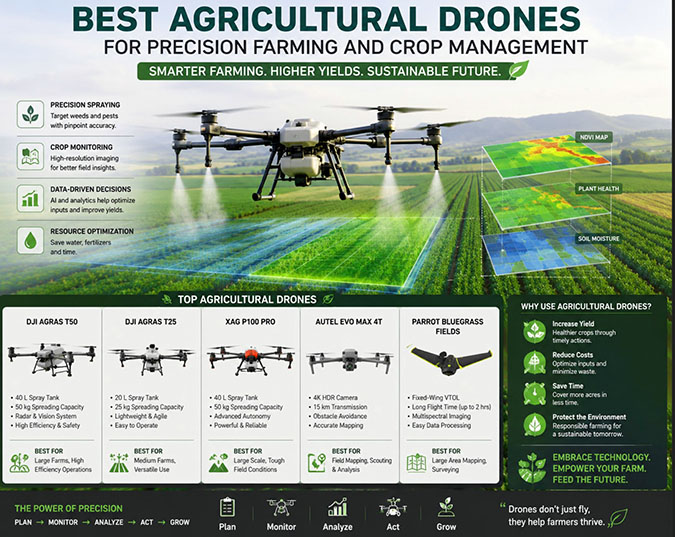
1. DJI Agras T50
The DJI Agras T50 represents one of the most advanced agricultural drones currently available. Designed specifically for large-scale farming operations, it combines spraying capabilities with mapping functions.
Key Features
- Large payload capacity for liquid applications.
- Advanced obstacle avoidance systems.
- Automated route planning.
- High-efficiency spraying technology.
- Compatibility with mapping software.
The T50 can cover extensive acreage in relatively short periods, making it ideal for commercial farms. Its precision spraying reduces overlap and ensures uniform treatment distribution.
Farmers cultivating rice, corn, wheat, and other broad-acre crops often consider this drone a worthwhile investment.
2. DJI Agras T25
For small and medium-sized farms, the DJI Agras T25 offers an excellent balance between affordability and functionality.
Key Features
- Compact and foldable design.
- Efficient spraying performance.
- User-friendly operation.
- Intelligent flight planning.
- Reliable obstacle sensing.
The T25 is particularly suitable for growers seeking professional drone capabilities without the operational demands associated with larger systems.
Its portability also makes transportation between multiple farming locations convenient.
3. XAG P100 Pro
XAG has become a respected name in agricultural automation, and the P100 Pro stands among its flagship offerings.
Key Features
- Precision variable-rate application.
- Autonomous flight operations.
- High-capacity spraying systems.
- Smart terrain adaptation.
- Integration with digital farm management platforms.
The P100 Pro excels in challenging landscapes where uneven terrain complicates conventional field operations.
Its advanced algorithms help maintain accurate application rates despite changes in elevation and crop canopy height.
4. Parrot Bluegrass Fields
While some agricultural drones focus on spraying, the Parrot Bluegrass Fields specializes in crop monitoring and data collection.
Key Features
- Multispectral imaging sensors.
- Vegetation index analysis.
- High-resolution RGB imagery.
- Easy data interpretation.
- Lightweight construction.
This drone enables farmers to monitor crop health using indicators such as NDVI (Normalized Difference Vegetation Index), which reveals variations in plant vigor and stress levels.
The information obtained helps identify affected areas before visible symptoms spread throughout the field.
5. senseFly eBee X
Fixed-wing drones remain popular among producers managing large properties. The senseFly eBee X is a leading option for aerial mapping and field analysis.
Key Features
- Extended flight duration.
- Coverage of large areas.
- Highly accurate mapping.
- Interchangeable sensors.
- Efficient data acquisition.
Unlike multirotor drones, fixed-wing models can remain airborne longer and survey hundreds of acres during a single mission.
This capability makes the eBee X particularly attractive for agricultural consultants and enterprise-scale operations.
Applications of Agricultural Drones
Agricultural drones extend far beyond simple photography. Their practical applications continue to expand across various farming activities.
Crop Health Assessment
Multispectral sensors capture information beyond the visible spectrum. By analyzing reflected light, drones can reveal plant stress caused by disease, nutrient deficiencies, or pest attacks.
Early detection allows farmers to intervene before yield losses become significant.
Precision Spraying
Modern spraying drones deliver fertilizers, herbicides, fungicides, and insecticides precisely where needed.
Benefits include:
- Reduced chemical consumption.
- Lower labor requirements.
- Improved worker safety.
- Enhanced application accuracy.
Irrigation Management
Water scarcity remains a major challenge worldwide. Drone imagery identifies dry zones and irrigation inefficiencies, enabling producers to allocate water resources more effectively.
This targeted approach supports both productivity and conservation goals.
Plant Counting and Emergence Monitoring
Shortly after planting, drones can estimate plant populations and identify gaps in emergence.
These insights help determine whether replanting is necessary and provide valuable information regarding seed performance.
Yield Prediction
Combining drone imagery with analytical software enables farmers to estimate future yields more accurately.
Improved forecasting assists with budgeting, marketing strategies, and logistical planning.
Factors to Consider When Choosing an Agricultural Drone
Selecting the right drone depends on several operational factors.
Farm Size
Large farms may benefit from fixed-wing drones capable of covering vast areas efficiently, while smaller operations often prefer multirotor models with greater maneuverability.
Intended Use
Determine whether the drone will primarily perform:
- Crop monitoring,
- Mapping,
- Spraying,
- Data collection,
- Or a combination of tasks.
Different systems excel in different applications.
Sensor Requirements
RGB cameras provide visual imagery, while multispectral and thermal sensors deliver deeper insights into crop conditions.
Choosing appropriate sensors ensures meaningful data collection.
Ease of Operation
User-friendly interfaces reduce training requirements and improve adoption rates.
Automated flight planning features can significantly simplify operations.
Regulatory Compliance
Drone regulations vary by country. Farmers should understand licensing requirements, operational limitations, and safety guidelines before deployment.
Compliance protects both operators and neighboring communities.
The Future of Agricultural Drones
The agricultural drone industry continues to evolve rapidly.
Artificial intelligence is enhancing image interpretation capabilities, allowing software to diagnose crop conditions automatically. Machine learning algorithms are becoming increasingly adept at identifying weeds, diseases, and nutrient deficiencies.
Swarm technology may eventually enable multiple drones to coordinate tasks simultaneously across extensive agricultural landscapes.
Battery improvements could extend flight durations, while autonomous charging stations may support uninterrupted operations.
As costs decline and technology becomes more accessible, agricultural drones are expected to become standard tools rather than specialized equipment reserved for large enterprises.
Conclusion
Agricultural drones have transformed precision farming by providing farmers with unprecedented visibility into their operations. From crop monitoring and irrigation management to targeted spraying and yield forecasting, these advanced systems support smarter decision-making and more efficient resource use.
The DJI Agras T50, DJI Agras T25, XAG P100 Pro, Parrot Bluegrass Fields, and senseFly eBee X represent some of the best options available for modern crop management. Each offers unique strengths suited to different farm sizes and objectives.
As global agriculture faces increasing pressure to feed growing populations while preserving natural resources, drone technology offers a practical pathway toward greater productivity and sustainability. Farmers who embrace these innovations today are positioning themselves to thrive in the data-driven future of agriculture.