Microsoft ERP Solution: The Digital Backbone of Modern Enterprise
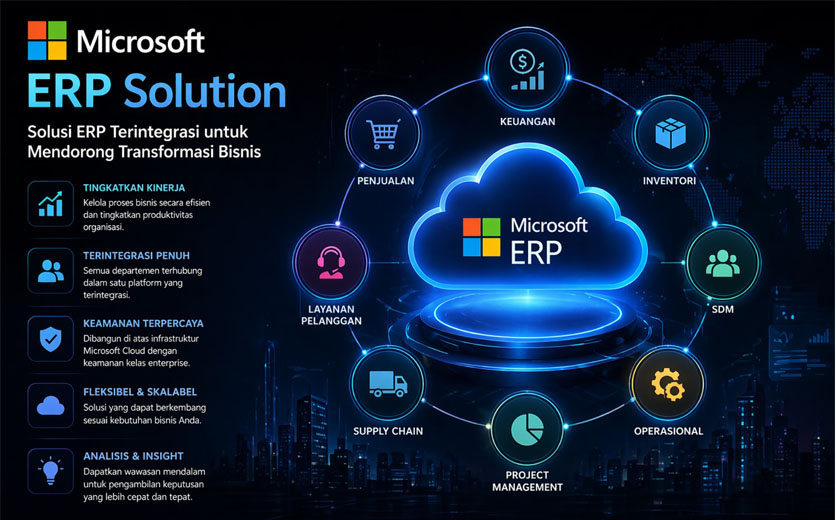
In the rapidly evolving landscape of 21st-century commerce, the traditional silos that once separated departments—finance, sales, human resources, and supply chain—have become liabilities. For a modern business to thrive, it requires more than just functional software; it requires a unified nervous system. This is the core philosophy behind the Microsoft ERP (Enterprise Resource Planning) solution, primarily embodied today in the Dynamics 365 ecosystem.
Microsoft has successfully transitioned from providing standalone accounting tools to offering a sophisticated, cloud-native suite that blends ERP with CRM (Customer Relationship Management), infused with cutting-edge Artificial Intelligence (AI).
The Evolution of Microsoft ERP
To understand where Microsoft is today, one must look at the heritage of its ERP offerings. Microsoft’s dominance in this space didn’t happen overnight; it was built through the strategic acquisition of proven industry leaders:
-
Dynamics AX (formerly Axapta): Designed for large, complex, international organizations.
-
Dynamics NAV (formerly Navision): The flexible workhorse for small to medium-sized enterprises (SMEs).
-
Dynamics GP (formerly Great Plains): Known for its robust financial management.
-
Dynamics SL (formerly Solomon): Specialized for project-based businesses.
Today, these legacy systems have evolved into Dynamics 365 Finance & Operations (aimed at the enterprise market) and Dynamics 365 Business Central (aimed at SMEs). This evolution represents a shift from “on-premise” servers to a “SaaS” (Software as a Service) model, allowing businesses to scale without the heavy burden of maintaining physical hardware.
Core Pillars of the Microsoft ERP Ecosystem
The Microsoft ERP solution is built on several foundational pillars that distinguish it from competitors like SAP or Oracle.
1. Unified Data and the “Dataverse”
At the heart of the Microsoft ecosystem is the Dataverse. Traditionally, ERP systems and CRM systems lived in separate databases, leading to “data friction.” If a salesperson closed a deal in the CRM, the finance team often had to manually re-enter that data into the ERP to generate an invoice. Microsoft eliminates this. By using a common data model, information flows seamlessly across the organization. A customer record in sales is the same customer record in accounting.
2. Seamless Integration with Microsoft 365
The greatest competitive advantage of Microsoft’s ERP is its familiarity. Most professionals already spend their day in Outlook, Excel, and Teams. Microsoft ERP solutions are natively integrated with these tools.
-
Excel: You can export data from the ERP to Excel, edit it, and “publish” those changes back to the ERP database with a single click.
-
Outlook: A user can view a customer’s credit limit or order history directly from an email sidebar without ever leaving their inbox.
-
Teams: Collaborative decision-making is enhanced by sharing live ERP dashboards within a Teams chat.
3. AI and “Copilot”
In 2024 and beyond, the defining feature of Microsoft ERP is Copilot, an AI-driven assistant. Copilot helps automate repetitive tasks, such as:
-
Predicting late payments based on historical customer behavior.
-
Generating product descriptions for e-commerce modules.
-
Reconciling complex bank statements.
-
Summarizing long procurement reports into actionable insights.
Deep Dive: Dynamics 365 Business Central vs. Finance & Supply Chain Management
Microsoft offers two primary paths for businesses, depending on their size and complexity.
Dynamics 365 Business Central (The SME Choice)
Business Central is an all-in-one management solution that is easy to implement and highly adaptable. It covers the essentials:
-
Financial Management: General ledger, accounts payable/receivable, and fixed assets.
-
Sales and Service: Quote-to-cash cycles and basic contact management.
-
Project Management: Resource tracking, capacity planning, and timesheets.
-
Supply Chain: Inventory control, basic warehousing, and purchasing.
It is the ideal choice for companies that have outgrown basic accounting software like QuickBooks but do not yet require the high-level complexity of a global enterprise suite.
Dynamics 365 Finance and Supply Chain Management (The Enterprise Choice)
For multinational corporations with complex manufacturing, multi-currency requirements, and intricate global tax compliance, this “Finance & Operations” (F&O) duo is the standard.
-
Advanced Manufacturing: Support for discrete, process, and lean manufacturing.
-
Global Logistics: Real-time visibility into shipping containers, landed costs, and port delays.
-
Strategic Finance: Tools for global consolidations, budget planning, and predictive forecasting.
The Role of the Power Platform
A unique aspect of the Microsoft ERP solution is the Power Platform, which allows businesses to customize their ERP experience without writing complex code.
-
Power BI: Visualizes ERP data into stunning, real-time dashboards.
-
Power Apps: Allows non-developers to build mobile apps (e.g., a warehouse worker using a custom app to scan barcodes that feed directly into the ERP).
-
Power Automate: Creates workflows that trigger actions across different systems (e.g., if a high-value order is placed, send an automatic approval request to the CFO).
Strategic Benefits of Choosing Microsoft
Choosing an ERP is a decade-long commitment. Businesses opt for Microsoft for several strategic reasons:
Scalability:
Because it resides on the Azure cloud, the ERP grows with you. Whether you have five users or five thousand, the infrastructure scales automatically. You only pay for what you use, turning capital expenditure (CapEx) into operational expenditure (OpEx).
Security and Compliance:
Microsoft spends billions annually on cybersecurity. Data stored within a Microsoft ERP is protected by enterprise-grade encryption, multi-factor authentication, and compliance certifications that meet the strictest global standards (GDPR, HIPAA, etc.).
Low Learning Curve:
Because the interface looks and feels like Windows and Office, employee “pushback” during implementation is significantly lower than with other ERP systems. The “UI/UX” (User Interface/User Experience) is intuitive, reducing training costs.
Challenges and Considerations
No solution is perfect. Implementing a Microsoft ERP requires a well-thought-out strategy.
-
Partner Dependency: Microsoft sells its ERP through a network of Value-Added Resellers (VARs). The success of your implementation often depends as much on the skill of your chosen partner as it does on the software itself.
-
Customization Overload: The flexibility of the system can be a double-edged sword. Over-customizing the ERP can make future updates more difficult. Experts recommend staying as close to “out-of-the-box” functionality as possible.
The Future: The Autonomous Enterprise
The future of Microsoft ERP is moving toward the “Autonomous Enterprise.” Imagine a system that doesn’t just record what happened yesterday, but suggests what should happen tomorrow. We are entering an era where the ERP will automatically reorder raw materials when it senses a disruption in the global supply chain, or adjust pricing dynamically based on market demand and competitor activity.
By integrating the Internet of Things (IoT), sensors on a factory floor can send data directly to the ERP. If a machine is vibrating at an unusual frequency, the ERP can automatically schedule a maintenance work order and pause production to prevent a more costly breakdown.
Conclusion
The Microsoft ERP solution is no longer just a “database for accountants.” It is a comprehensive, AI-powered platform that empowers every employee—from the warehouse floor to the C-suite—to make data-driven decisions. By leveraging the power of the cloud, the familiarity of Office tools, and the intelligence of the Power Platform, Microsoft has created an ecosystem that allows businesses to be more agile, resilient, and competitive in an unpredictable global market. For any organization looking to undergo a digital transformation, Dynamics 365 is not just a software choice; it is a strategic foundation for the future.