How Cloud-Based Farm Management Software Improves Agricultural Profits
Agriculture has always been a business built on experience, hard work, and careful decision-making. However, modern farming faces challenges that previous generations never had to consider. Rising production costs, climate uncertainty, labor shortages, market fluctuations, and increasing consumer expectations have transformed agriculture into a highly data-driven industry.
To remain competitive, farmers must make smarter decisions faster than ever before. This is where cloud-based farm management software has emerged as a valuable tool. By bringing together data, analytics, and real-time insights, these digital platforms help farmers improve productivity, reduce waste, and ultimately increase profitability.
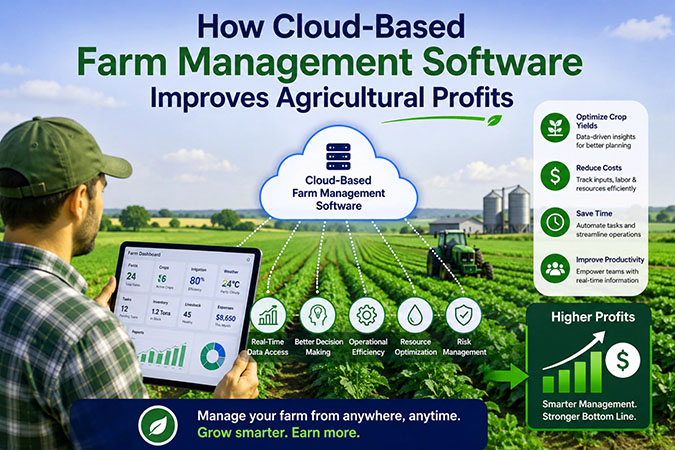
Understanding Cloud-Based Farm Management Software
Cloud-based farm management software refers to digital platforms hosted on remote servers and accessed through the internet. Unlike traditional desktop applications that operate on a single computer, cloud solutions allow users to access information from smartphones, tablets, or laptops anytime and from virtually anywhere.
These platforms typically integrate multiple farming functions into one centralized system, including:
- Crop planning and monitoring
- Field mapping
- Financial management
- Inventory tracking
- Labor management
- Equipment maintenance scheduling
- Weather forecasting
- Irrigation planning
- Compliance reporting
- Yield analysis
Because all information is stored in the cloud, data remains secure, synchronized, and accessible to authorized users across different locations.
Improved Decision-Making Through Real-Time Data
One of the most significant advantages of cloud-based software is access to real-time information.
Traditional farming often relies on handwritten notes, spreadsheets, and memory. While experience remains valuable, manual methods can lead to delays and inaccuracies. Cloud systems continuously collect and organize data from various sources, enabling farmers to make informed decisions quickly.
For example, a farmer can monitor:
- Soil moisture levels
- Crop growth stages
- Pest outbreaks
- Weather developments
- Fertilizer applications
- Machinery performance
Instead of reacting after problems occur, producers can identify potential issues early and take preventive action. Faster responses often translate into lower losses and improved crop outcomes.
Reducing Input Costs
Agricultural inputs represent a major portion of farm expenses. Seeds, fertilizers, pesticides, fuel, and irrigation costs continue to rise each year.
Cloud-based management platforms help optimize the use of these resources.
By analyzing field-specific data, farmers can apply inputs only where they are needed. This precision reduces unnecessary spending while maintaining or improving yields.
Examples include:
Precision Fertilizer Application
Different areas within a field may require varying nutrient levels. Software-generated recommendations allow targeted fertilizer applications rather than blanket treatments.
This approach lowers fertilizer expenses and minimizes nutrient runoff.
Efficient Water Usage
Irrigation scheduling tools combine weather forecasts, soil conditions, and crop requirements to determine the ideal watering schedule.
Avoiding over-irrigation saves water, electricity, and pumping costs.
Smarter Pest Control
Integrated pest monitoring alerts farmers to emerging threats before infestations spread widely.
Early intervention often requires fewer chemical applications, reducing both expenses and environmental impact.
Increasing Crop Productivity
Higher yields remain one of the most direct paths to improved profitability.
Cloud-based systems contribute to better productivity by identifying factors that influence crop performance.
Historical records enable farmers to compare seasons and evaluate which practices deliver the best results. They can analyze questions such as:
- Which seed varieties performed best?
- Which planting dates generated higher yields?
- How did weather conditions affect production?
- Which fertilizer programs produced the strongest returns?
These insights support continuous improvement.
Rather than relying solely on tradition, producers can adopt strategies supported by actual farm data.
Over time, incremental gains in productivity can significantly boost revenue.
Enhancing Financial Management
Many farms operate with narrow profit margins. Understanding exactly where money is earned and spent is essential.
Cloud-based software simplifies financial oversight through features such as:
- Expense tracking
- Budget planning
- Profit-and-loss reporting
- Invoice management
- Cost-per-acre calculations
- Revenue forecasting
Farm managers can quickly identify unprofitable activities and redirect resources toward higher-performing operations.
For example, if one crop consistently generates stronger returns than another, financial reports provide evidence to support future planting decisions.
Clear visibility into finances also improves relationships with lenders, investors, and business partners.
Better Labor Management
Labor shortages have become a major concern across the agricultural sector.
Managing seasonal workers efficiently can influence profitability just as much as crop performance.
Cloud-based platforms help coordinate workforce activities by allowing managers to:
- Assign tasks digitally
- Track completed work
- Monitor labor hours
- Evaluate productivity
- Improve communication among teams
Supervisors no longer need to rely exclusively on paper logs or verbal instructions.
Efficient labor allocation reduces downtime and ensures critical tasks such as planting, spraying, and harvesting occur on schedule.
Delayed operations can directly affect yields and income. Therefore, effective workforce coordination contributes substantially to profitability.
Improved Equipment Utilization
Farm machinery represents one of agriculture’s largest capital investments.
Unexpected equipment breakdowns can disrupt operations and create costly delays during crucial periods.
Cloud-based management systems track maintenance schedules, operating hours, and repair histories.
Farm managers receive reminders for preventive servicing, helping extend machinery lifespan and reduce emergency repair expenses.
Additionally, usage reports can reveal underutilized equipment.
Instead of purchasing unnecessary machinery, producers can optimize existing assets and improve return on investment.
Supporting Risk Management
Farming involves numerous uncertainties, including:
- Extreme weather events
- Market volatility
- Pest outbreaks
- Disease pressure
- Supply chain disruptions
Although software cannot eliminate these risks, it improves preparedness.
Weather integration tools provide forecasts that support operational planning. Farmers can adjust planting schedules, postpone spraying during high winds, or prepare irrigation systems during drought conditions.
Historical records also strengthen insurance claims and document losses when disasters occur.
Access to accurate information enables producers to respond strategically rather than emotionally.
Improving Traceability and Compliance
Consumers increasingly want transparency regarding how food is produced.
Governments and buyers also impose stricter requirements related to sustainability, food safety, and environmental responsibility.
Cloud-based systems automatically document farming activities, including:
- Chemical applications
- Harvest dates
- Field operations
- Employee activities
- Storage records
Maintaining detailed records manually can be time-consuming and prone to errors.
Digital documentation simplifies audits and compliance reporting.
For farms selling into premium markets, strong traceability can create opportunities to secure higher prices and long-term contracts.
Facilitating Collaboration
Modern farming often involves multiple stakeholders.
Owners, managers, agronomists, consultants, suppliers, and family members may all participate in decision-making.
Cloud technology enables authorized users to access the same information simultaneously.
This shared visibility encourages collaboration and reduces misunderstandings.
Agronomists can review crop data remotely and recommend interventions without traveling to the farm.
Accountants can access financial reports when needed.
Family members involved in management can stay informed regardless of location.
Improved communication leads to better coordination and stronger business outcomes.
Scalability for Growing Operations
As farms expand, operational complexity increases.
Managing thousands of acres using notebooks and disconnected spreadsheets becomes increasingly difficult.
Cloud-based solutions offer scalability without requiring extensive information technology infrastructure.
Whether a producer manages fifty acres or several thousand, software capabilities can grow alongside the business.
New fields, employees, equipment, and enterprises can be added without replacing the entire system.
This flexibility allows agricultural businesses to evolve efficiently while maintaining control over their operations.
Environmental Sustainability and Profitability
Sustainability and profitability are often viewed as competing priorities. In reality, efficient resource management benefits both.
Reducing excess fertilizer use lowers costs and protects waterways.
Optimized irrigation conserves water while decreasing energy expenses.
Targeted pesticide applications minimize chemical dependence and improve ecosystem health.
Consumers and buyers increasingly reward environmentally responsible practices through preferred supplier relationships and premium pricing opportunities.
Cloud-based technologies help farmers demonstrate these efforts through reliable documentation and measurable outcomes.
Challenges to Consider
Despite the benefits, implementation requires careful planning.
Some farmers may face challenges such as:
- Initial subscription costs
- Internet connectivity limitations
- Employee training requirements
- Resistance to adopting new technologies
- Data integration issues with existing systems
However, many providers offer scalable pricing models and user-friendly interfaces designed specifically for agricultural operations.
The long-term financial gains frequently outweigh the early investment.
Success depends on selecting software that aligns with the farm’s size, goals, and production systems.
Conclusion
Agriculture is evolving rapidly, and profitability increasingly depends on the ability to transform information into action.
Cloud-based farm management software empowers producers with real-time insights, stronger financial oversight, improved resource efficiency, and enhanced operational control. From reducing input costs and increasing yields to streamlining labor and maintaining compliance, these platforms address many of the challenges facing modern agriculture.
Technology alone cannot guarantee success. Sound judgment, farming expertise, and adaptability remain essential. Yet when combined with practical experience, cloud-based solutions become powerful tools for improving decision-making and strengthening farm profitability.
As the global agricultural landscape grows more competitive, farmers who embrace digital innovation may be better positioned not only to survive but to thrive. By investing in smarter management practices today, agricultural businesses can build more resilient, efficient, and profitable operations for the future.